The Healing Power of Sound: What Happens During a Sound Bath? |
Ancient traditions have recognized the transformative power of sound for millennia. Today, modern science is illuminating just how deeply sound can affect the brain, body, nervous system, and consciousness. |
There comes a moment in a sound bath when you stop simply hearing the sound.
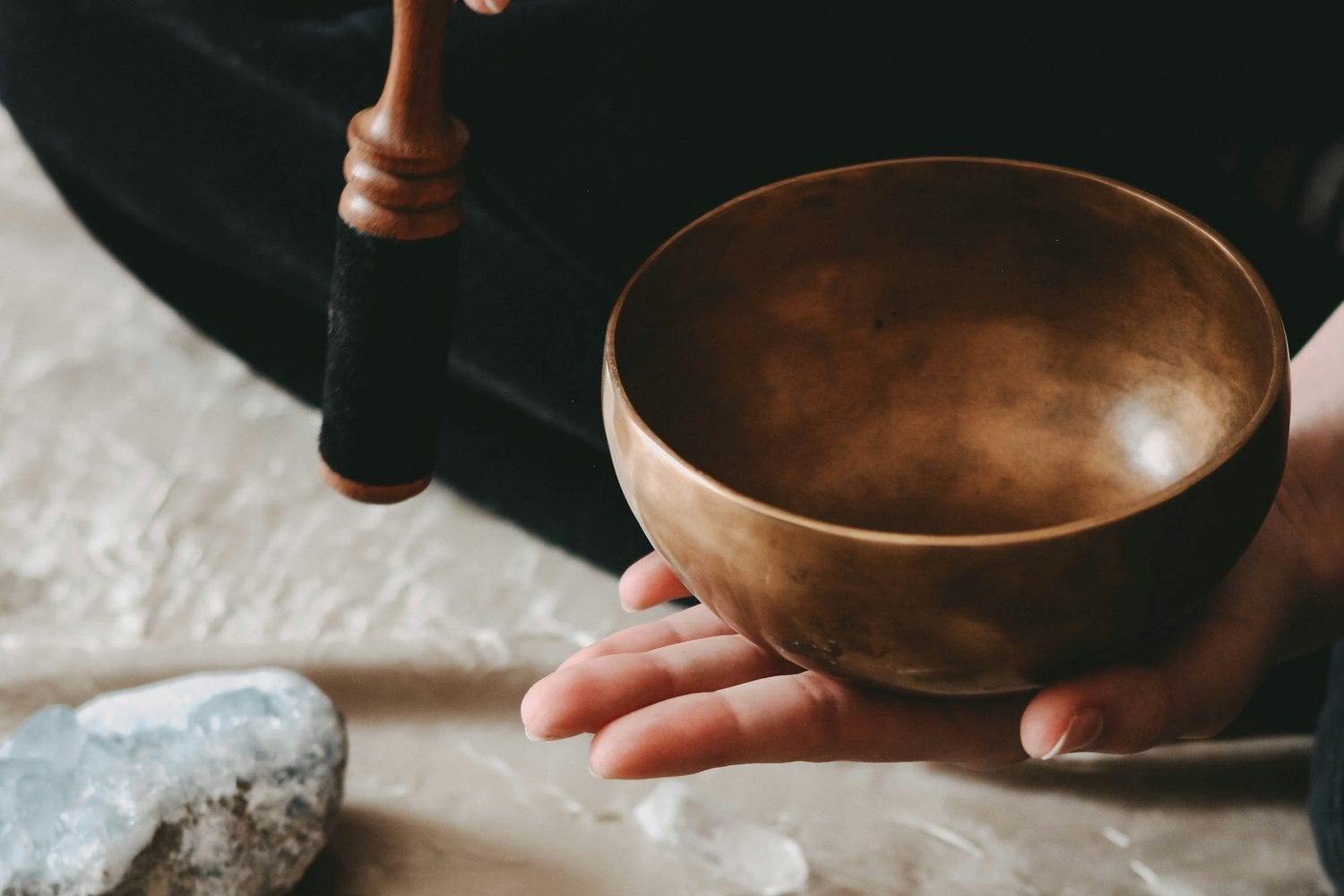
A singing bowl rings and its tone expands into layers of shimmering harmonics. Another joins it. Perhaps a gong begins to swell, so softly at first that you aren't quite sure whether you're hearing it or feeling it. The vibrations seem to occupy the room and, somehow, your body too.
Your breathing slows. Muscles you didn't realize you were holding begin to soften. Thoughts that felt terribly important a few minutes ago start losing their grip.
And somewhere along the way, listening becomes something closer to receiving.
This is the world of the sound bath, an ancient-meets-modern practice experiencing a remarkable resurgence as more people seek ways to quiet overstimulated minds, soothe stressed nervous systems, and reconnect with themselves.
As a sound healer, I am an enthusiastic advocate for the practice. There is something extraordinary about watching a room full of people arrive carrying the accumulated noise of their lives and gradually surrender into stillness as sound fills the space.
But what makes sound capable of affecting us so profoundly?
The answer begins with something deceptively simple: Sound is vibration.
More Than Something We Hear Before sound becomes a favorite song, a spoken word, or the ringing of a crystal bowl, it exists as mechanical vibration traveling through matter.
When those pressure waves reach our ears, an intricate chain of events transforms physical vibration into electrical and chemical signals the brain can interpret.
But sound isn't experienced exclusively through the ears.
Anyone who has stood near a large gong, drum, or powerful bass speaker knows this intuitively. Low-frequency sound can be experienced physically. A gong doesn't merely ring in the room. You can feel it in your chest. The resonance of a singing bowl can seem almost tactile.
A sound bath builds upon this intimate relationship between sound and the human organism.
Participants generally lie comfortably while a practitioner creates an immersive soundscape using some combination of Himalayan or metal singing bowls, crystal bowls, gongs, bells, chimes, drums, tuning forks, rattles, and the human voice.
There is very little to accomplish.
No meditation expertise is required. There is no need to stop thinking, visualize correctly, or force yourself to relax.
You simply receive.
And for people who struggle with traditional silent meditation, that can be remarkably freeing.
An Ancient Relationship With Sound Our fascination with therapeutic sound is anything but new.
Across cultures and centuries, human beings have used chanting, drumming, bells, mantras, singing, toning, prayer, and sacred music to facilitate healing, meditation, ceremony, and altered states of consciousness.
Different traditions developed different explanations for why these practices worked. What they shared was an understanding born from experience:
Sound can change our state.
Long before EEG machines could measure electrical activity in the brain or wearable devices could calculate heart-rate variability, human beings observed what happened when they chanted together, beat drums rhythmically, rang bells, sang prayers, or entered sustained periods of resonance and vibration.
They didn't call it neuroscience.
They experienced it.
In more recent decades, physicians, neuroscientists, musicians, psychologists, and consciousness researchers have begun examining sound through the instruments and language of modern science.
The late oncologist Mitchell L. Gaynor, M.D., was among the physicians who brought sound explicitly into conversations about integrative medicine. In The Healing Power of Sound, Gaynor explored music, voice, breathing, meditation, toning, and singing bowls as part of a broader mind-body-spirit approach to healing and wellness.
Neurologist and Ayurvedic practitioner Kulreet Chaudhary, M.D., approaches sound through both ancient mantra traditions and modern understandings of the brain and body in Sound Medicine.
And Drs. J.J. and Desiree Hurtak extend the conversation into chanting, toning, music, healing frequencies, and the spiritual and transcendent dimensions of human experience.
Different lenses. Different vocabularies.
But a remarkably persistent question:
What happens when we intentionally use sound to change our state of being?
Your Brain on Sound To begin answering that question, we can look at the brain. Neuroscientist and musician Daniel J. Levitin has spent much of his career exploring what happens when sound becomes music inside the human mind.
In This Is Your Brain on Music, Levitin describes musical experience not as the work of one isolated "music center" in the brain, but as an intricate neurological undertaking involving systems associated with auditory perception, attention, memory, emotion, expectation, timing, and movement.
When we listen, in other words, the brain is doing far more than simply registering sound.
It is detecting patterns.
Anticipating what might come next.
Comparing what it hears with what it has heard before.
Remembering.
Organizing.
Responding emotionally.
The auditory experience is extraordinarily active.
And rhythm adds another fascinating dimension.
Our brains continually produce patterns of electrical activity commonly grouped into frequency ranges. Beta activity is broadly associated with active waking cognition; alpha with relaxed wakefulness; theta becomes more prominent during drowsiness, imagery, and some meditative states; and delta is strongly associated with deep sleep.
These aren't rigid compartments, and the brain doesn't operate at only one frequency at a time. But changing patterns of brainwave activity give researchers one window into changing states of consciousness.
And sound can interact with neural activity.
When Sound Changes State One fascinating area of research involves auditory entrainment and what is known as the frequency-following response: the tendency of neural activity to synchronize in measurable ways with repetitive auditory stimulation.
This principle has been explored particularly through technologies such as binaural beats, in which slightly different frequencies are presented separately to each ear, producing the perception of an additional rhythmic beat.
Robert Monroe began experimenting with the effects of sound on consciousness decades ago. That exploration eventually contributed to Hemi-Sync, the audio technology associated with The Monroe Institute and its well-known Gateway programs.
The larger idea was audacious for its time: could sound be deliberately designed to help facilitate particular states of consciousness?
The Monroe Institute's work helped bring that question into popular consciousness, while scientists have continued investigating auditory stimulation, binaural beats, neural synchronization, and brainwave activity.
A 2023 systematic review examining binaural-beat research found evidence of changes in EEG activity in some studies, including activity involving theta, alpha, and gamma bands, while finding considerable differences among experimental results and methodologies.
A sound bath is not Hemi-Sync, and the complex acoustics created by singing bowls and gongs shouldn't be equated with precisely engineered binaural-beat recordings.
But they belong to the same larger and fascinating conversation: Sound doesn't simply enter our awareness. The brain responds to it.
And anyone who has experienced the transition from ordinary mental chatter into the deeply relaxed, dreamlike quality that can emerge during a sound bath knows why that question is so compelling.
When the Nervous System Gets the Message Then there is the response sound-bath participants often notice without knowing anything about neuroscience.
The exhale gets longer.
The shoulders drop.
The jaw unclenches.
The body settles.
Our autonomic nervous system continually helps regulate processes such as heart rate, respiration, and digestion while responding to cues from our internal and external environments.
A sound bath creates an unusually rich environment for settling: lying down, closing the eyes, slowing the breath, sustained tones, rhythmic repetition, focused attention, reduced external stimulation, and the permission, perhaps for the first time that day, to do absolutely nothing.
And sound itself is part of that experience.
This is one reason the effects of a sound bath need not be reduced to a single frequency, instrument, or mechanism.
There is sound, vibration, resonance, attention, breath, stillness, environment, expectation, emotion, and human consciousness all participating in the experience.
Increasingly, researchers are attempting to measure the result.
The Science Is Catching Up One frequently cited study followed 62 adults before and after a sound meditation using primarily Tibetan singing bowls, along with bells, gongs, and other instruments.
Following the session, participants reported significantly less tension, anger, fatigue, and depressed mood. Researchers also observed changes in measures involving anxiety, pain, and spiritual well-being. Interestingly, participants who were new to this kind of meditation experienced a greater reduction in tension than those who had done it before.
And the research has continued to grow.
A 2025 systematic review examined 19 clinical studies from eight countries, including nine randomized controlled trials. Singing-bowl interventions had been investigated in relation to anxiety, depression, sleep, cognitive function, and various physiological and neurological measures.
The researchers concluded that singing-bowl interventions showed therapeutic potential across several areas, particularly anxiety, depression, sleep, and cognitive function, while also calling for additional rigorous research.
For a healing practice whose origins lie far outside the modern clinical laboratory, the growing scientific interest is exciting.
But perhaps the most interesting story isn't that science is finally determining whether humanity was "right" about sound.
It is that we now possess tools capable of observing dimensions of an experience humans have been exploring for millennia.
Science gives us another language.
It doesn't have to replace the ancient one.
Sound as a Healing Practice Healing does not always begin with doing more.
Sometimes it begins with becoming still enough to receive.
This is one of the reasons I am such an advocate for sound baths. Sound offers an extraordinarily accessible doorway into that state without requiring us to wrestle the mind into silence.
The experience can be deeply restorative.
Some people experience profound relaxation. Others encounter emotion, imagery, physical sensations, or a changed perception of time. Some enter deeply meditative states. Some drift toward sleep. Others describe spaciousness, clarity, connectedness, or peace.
Healing can take many forms.
It can look like releasing tension.
Quieting a relentlessly busy mind.
Allowing an overtaxed nervous system to settle.
Moving through emotion.
Returning awareness to the body.
Experiencing deep rest.
Reconnecting with ourselves.
Creating enough internal spaciousness for something to shift.
Sound has accompanied human beings through healing, grief, celebration, worship, meditation, birth, death, and transformation across cultures and across time.
Perhaps our ancestors did not need an EEG to know that chanting could alter consciousness or that rhythm could change the state of a gathering.
They knew because they experienced it.
Modern science now gives us the extraordinary opportunity to look more closely at what humanity has known through observation, tradition, and direct experience, while the experience itself remains something no graph can entirely capture.
Because anyone who has lain inside the swelling resonance of a gong knows there is a point at which sound becomes more than something heard.
You feel it.
What to Expect at Your First Sound Bath If you've never experienced a sound bath, there is wonderfully little you need to know beforehand.
Come as you are.
Most sound baths invite participants to lie on a yoga mat or recline comfortably, often with blankets, pillows, or an eye covering. Once settled, there is usually nothing required of you except to listen and allow yourself to experience what unfolds.
And your experience doesn't need to look like anyone else's.
You may feel vibration moving through different parts of your body. You may notice your breathing change. Your thoughts may slow. Memories or emotions may surface. You might enter a deeply meditative state.
You might fall asleep.
You might simply spend an hour feeling exquisitely relaxed.
All of those experiences are allowed.
There is no gold star for achieving transcendence.
As a sound healer, I think one of the most beautiful things about the practice is precisely that it asks so little of us.
In a culture continually demanding that we perform, improve, produce, optimize, and become something more, a sound bath offers a radically different invitation:
Lie down.
Listen.
Receive.
And notice what becomes possible when, for a little while, you stop trying so hard to make something happen.
The Medicine of Resonance We are living through an interesting moment.
Ancient wisdom traditions are being rediscovered. Neuroscience is giving us increasingly sophisticated ways of observing the brain. Researchers are investigating meditation, breathwork, music, rhythm, vibration, and sound. And people who might never have considered themselves meditators are walking into sound baths and discovering what can happen when they become still inside a field of resonance.
Perhaps that convergence shouldn't surprise us.
We are rhythmic beings.
The heart beats.
The lungs expand and contract.
Neural activity oscillates.
We speak in cadence.
We move to rhythm.
A familiar song can transport us decades into the past within seconds. A lullaby can soothe a child before that child could possibly understand its words. A drumbeat can make a roomful of bodies want to move. A piece of music can bring tears before the conscious mind has formulated a reason for them.
Sound has always been part of us.
Perhaps what practices such as the sound bath offer isn't something entirely new.
Perhaps they invite us to remember an ancient relationship we never truly lost:
the relationship between vibration, consciousness, stillness, and healing.
And sometimes, beautifully, it takes sound to lead us back to silence.
Experience a Sound BathIf this article has you curious about experiencing a sound bath for yourself, I'd be delighted to welcome you into one.
As a trained sound healer, I offer private and group sound bath experiences in the Orlando area, creating immersive spaces for deep rest, meditation, nervous system regulation, and reconnection through therapeutic sound.
Watch Resonant for upcoming sound experiences, or if you're curious about a private or group experience, leave me a note in the comments below.
And I'd love to hear from you: Have you ever experienced a sound bath? What did you notice during or afterward? If you haven't tried one yet, what are you most curious about? |
More from Resonant

Sep 29, 2026
Orlando’s Conscious Community Is Hiding in Plain Sight
There’s another side of Central Florida waiting to be discovered.

Sep 27, 2026
When Did You Stop Feeling Like Yourself?
Maybe what you’re calling burnout is something deeper: a loss of resonance with yourself.
0 Comments
Join the conversation
Be the first to comment
Share your thoughts above.