Orlando’s Labyrinths: Ancient Practice Hiding in Modern Florida |
Across Central Florida, ancient pathways invite us to walk inward. But a labyrinth may be more than a path for contemplation. For centuries, it has been understood as a pattern of pilgrimage, transformation and return. |
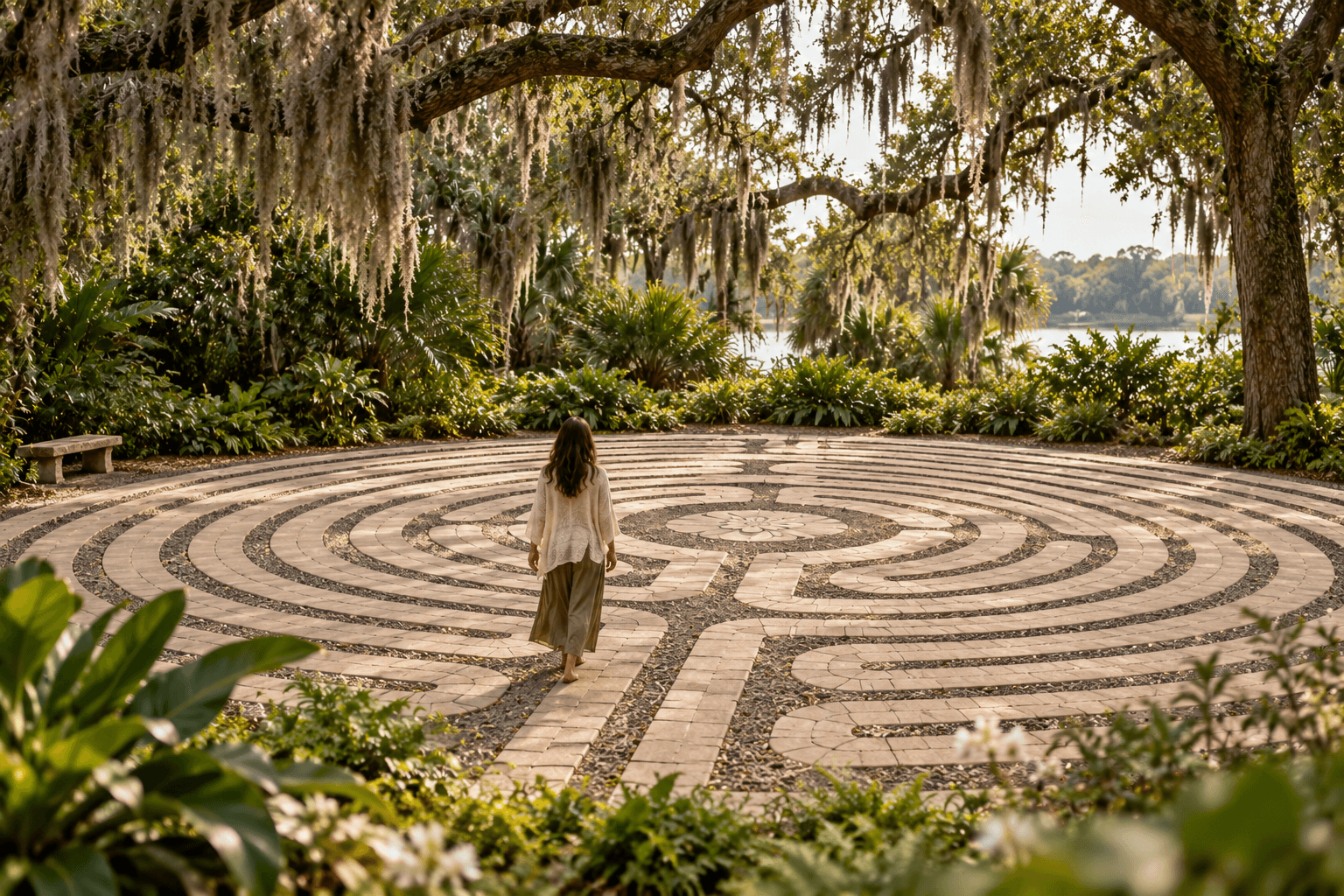
You stand at the entrance and can already see the center.
It doesn't look very far away.
And yet, you cannot simply walk toward it.
The path takes you closer, then turns.
Closer again, then away.
At certain moments, you may find yourself only a few steps from the center while the path carries you in precisely the opposite direction.
There are no signs telling you what to do.
There are no choices to make.
There is nowhere to get lost.
And perhaps that is the first teaching of the labyrinth.
You can be moving away from the center and still be on the path toward it.
I've walked labyrinths here in Central Florida, and there is something about the experience that is difficult to understand by looking at one from the outside.
Because a labyrinth isn't really something you look at.
You enter it.
And once you do, the geometry is no longer beneath your gaze.
It is beneath your feet.
A Labyrinth Is Not a Maze
We tend to use the words interchangeably, but they describe fundamentally different experiences.
A maze is designed around choice. It branches. It confuses. There are wrong turns and dead ends. Its challenge is to figure out how to reach the destination.
A traditional labyrinth is unicursal.
One continuous path leads toward the center. That same journey carries you outward again.
There is nothing to solve.
The question is not Which way should I go?
The path has already answered that.
The question becomes:
How will I walk it?
Slowly or quickly.
Prayerfully or playfully.
With a question.
With grief.
With gratitude.
With an intention.
Or perhaps with nothing at all.
That distinction transforms the labyrinth from puzzle into practice. And versions of that practice have appeared across human history in different cultures, eras and spiritual contexts.
One of the forms most recognizable today is the great medieval labyrinth at Chartres Cathedral in France, whose circular geometry and winding path have inspired labyrinths around the world.
Including some hiding right here in Central Florida.
When the Body Enters the Geometry
This is where the labyrinth becomes especially interesting to me.
Sacred geometry begins with an ancient proposition: form has meaning.
The circle.
The center.
The circumference.
The spiral.
Symmetry.
Proportion.
These are not merely pleasing shapes within many esoteric traditions. They are understood as expressions of underlying order: patterns through which the invisible becomes visible.
A circle has no beginning and no end.
Its circumference exists in relationship to a center that remains still.
Move around the outside and everything changes.
The center does not.
That alone has given contemplatives enough material for centuries.
But a labyrinth does something unusual with sacred geometry.
It makes the geometry walkable.
Instead of contemplating the symbol from outside, the human body enters it.
Your feet trace the pattern.
Your orientation continually changes.
You approach the center.
Turn away from it.
Circle it.
Lose sight of your progress.
Approach again.
And eventually arrive.
One metaphysical way of understanding the labyrinth is therefore not simply as a representation of the inner journey, but as an embodied technology for making that journey.
The word technology may sound strange here.
But technology need not mean electronics or machinery. At its simplest, it can mean an intentionally created method through which something is accomplished.
Seen that way, the labyrinth is remarkably sophisticated.
The technology is the pattern.
The instrument is the human body.
And the practice begins when the two meet.
Release. Receive. Return.
There are many ways to walk a labyrinth, but one framework found within contemporary Christian labyrinth practice is particularly beautiful.
On the journey inward, release.
What are you carrying that you no longer need to carry?
A fear.
A resentment.
A question you have been trying too hard to answer.
An identity that no longer fits.
A story whose time has passed.
Then comes the center.
Receive.
Not necessarily an answer.
Perhaps an insight. A sensation. A silence. A remembering.
Perhaps nothing that can be named at all.
Stay as long as you wish.
And then turn.
Because reaching the center is not the end of a labyrinth.
You must walk back out.
Return.
The same path that carried you inward now leads you into the world again.
At St. Mary Magdalen Catholic Church, a 30-foot prayer-garden labyrinth dedicated in 2022 follows a Chartres-inspired design. Its own tradition describes precisely this three-part movement: letting go while walking inward, dwelling at the center in relationship with God, and returning outward renewed.
There is something profound in the fact that the practice doesn't leave us at the center.
Whatever happens there has to come home with us.
A Whole-Body Prayer in Winter Park
At San Pedro Spiritual Development Center, the labyrinth rests within more than 200 acres surrounding Lake Howell, alongside walking paths, woods and spaces for prayer and retreat.
San Pedro describes walking its labyrinth as a whole-body prayer. That phrase captures something essential.
We often imagine spiritual practice happening primarily in the mind: contemplation, belief, visualization, prayer.
The labyrinth asks the body to participate.
Walk.
Turn.
Breathe.
Notice.
San Pedro encourages walkers to pay attention to their bodies, thoughts and feelings; to pause in the center if they wish; and, importantly, to remain attentive to the experience after leaving the labyrinth.
The walk doesn't necessarily announce what it has done.
Sometimes understanding comes later.
Sacred Paths in Unexpected Places
Not every Central Florida labyrinth belongs to the same tradition.
That's part of their beauty.
At First Unitarian Church of Orlando, a large circular arrangement of stones sits between buildings on the church campus and is used for walking meditation.
The surrounding community is intentionally broad in its spiritual outlook. Unitarian Universalism welcomes diverse beliefs rather than requiring a shared creed, making the labyrinth particularly fitting: one path can be walked with many understandings of what the center means.
At Unity of Central Florida, another permanent labyrinth invites the community into contemplative practice. The seven-circuit, Chartres-style design sits outdoors on the church's wooded campus and has been used for gatherings including World Labyrinth Day, when participants walk intentionally alongside people around the world.
Here, too, the labyrinth becomes more than a pattern on the ground.
It becomes a place to quiet the mind, create inner spaciousness and enter the geometry with intention.
Elsewhere in Orlando, labyrinths carry memory.
At Colonialtown Square Park, an 11-circuit medieval-style labyrinth was created as a memorial to the 49 lives taken at Pulse.
There, walking inward takes on another dimension.
Grief itself is rarely linear.
We think we have moved beyond something and suddenly find ourselves circling it again.
We approach acceptance and then feel carried away from it.
Memory returns.
The path turns.
We continue.
The geometry doesn't demand that grief move in a straight line. Neither does the human heart.
And then there is perhaps one of the most poignant places to find a labyrinth at all.
On a fourth-floor terrace at Orlando Health Cancer Institute's Charles Lewis Pavilion sits a labyrinth modeled after the one at Chartres Cathedral. Orlando Health describes it as a space for patients, families, staff and members of the community to use for walking meditation and calming reflection.
Here, the ancient geometry exists alongside cancer treatment, not as another problem to solve, but as a place to walk when life itself has become uncertain.
Orlando Health has described labyrinth walking as both walking meditation and embodied prayer.
That phrase may hold one of the labyrinth's deepest mysteries.
The body enters the prayer.
What If the Pattern Is the Practice?
There is another idea about labyrinths that fascinates me.
What if walking one isn't merely symbolic?
Within metaphysical and esoteric traditions, sacred geometry is sometimes understood not simply as decoration or representation but as an ordering principle.
From that perspective, moving consciously through geometric form becomes a kind of participation in the pattern itself.
The walker isn't observing the symbol.
She is activating it through movement.
Step after step, turn after turn, the body becomes part of the geometry.
Perhaps that is one reason labyrinth experiences can feel so different from simply sitting quietly.
The mind may wander, but the feet continue.
The body remembers the path even when thought becomes noisy.
Eventually rhythm takes over.
And something shifts.
People have walked labyrinths in prayer, mourning, celebration, discernment, pilgrimage and healing. Others enter simply because they are curious.
No two walks need to mean the same thing.
The labyrinth does not tell you what revelation to have.
It gives you a pattern through which to listen.
Orlando’s Labyrinths Are Hiding in Plain Sight
Once you begin noticing them, they seem to appear in the most unexpected places.
On church grounds.
At retreat centers.
In public parks and memorial spaces.
Among gardens.
Even at a cancer treatment center.
Places we may have driven past dozens of times without realizing an ancient contemplative pattern was waiting nearby.
And perhaps that is appropriate.
A labyrinth doesn't shout for our attention.
It waits.
There is no finish line to conquer, no puzzle to solve, no achievement waiting at the center.
Only an entrance.
A path.
A center.
And a return.
The next time you encounter one, resist the temptation to understand it before entering.
Stand at the threshold for a moment.
Choose something you are willing to release, or choose nothing at all.
Then walk.
Notice what happens when the path takes you away from the center you thought you were approaching.
Notice what happens when it brings you close again.
Notice your breathing.
Your thoughts.
Your body.
Stay awhile when you arrive.
And when you are ready, turn around.
Because the deepest teaching of the labyrinth may not be found in reaching its center.
It may be found in what happens next:
You walk back into the world carrying whatever you discovered there. |
More from Resonant

Oct 6, 2026
Your Home Is an Ecosystem
What kind of life does your home make possible?

Oct 6, 2026
What Are You Consuming Besides Food?
We pay extraordinary attention to what enters our bodies. Perhaps it’s time to notice what enters our minds.
Oct 6, 2026
The Quiet Luxury of an Afternoon at Leu Gardens
A botanical escape in the heart of Orlando invites us to slow down, wander without an agenda and reconnect with the place we call home.

Oct 5, 2026
Everything Connects
An Introduction to BioAwareness™
0 Comments
Join the conversation
Be the first to comment
Share your thoughts above.