What Happens When Women Become the Elders? |
We have spent enormous cultural energy asking how a woman can remain young. Perhaps it is time to become equally fascinated by the extraordinary woman she is becoming. |
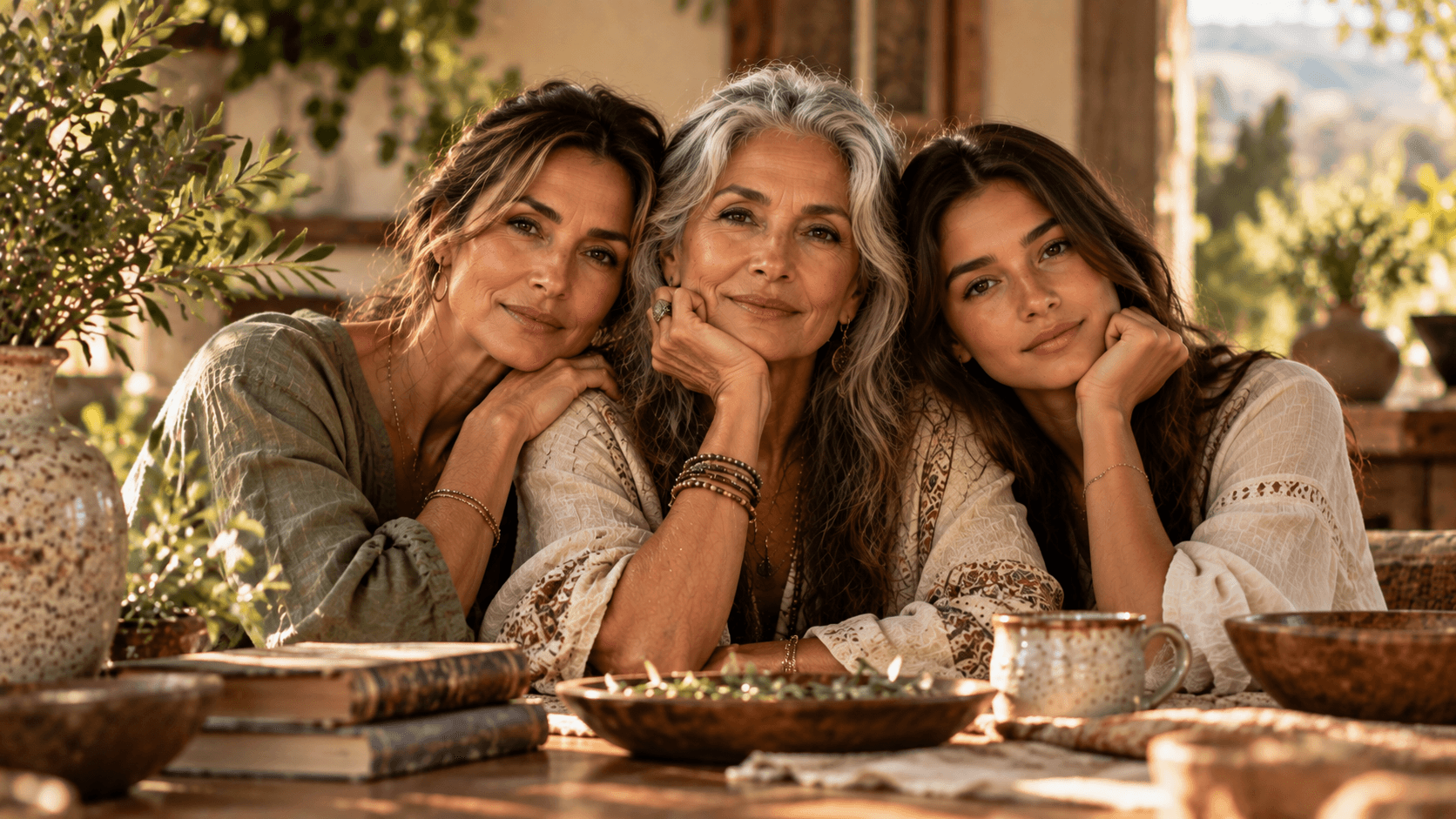
There is an entire vocabulary available to women who are growing older.
We are encouraged to age gracefully, age well, preserve our skin, maintain our vitality, and remain youthful for as long as possible. We can even pursue something called “anti-aging,” as though the passage of time were something to resist rather than an extraordinary privilege to experience.
What we hear considerably less about is what a woman might be growing into.
That interests me because somewhere between our cultural fascination with youth and our very legitimate desire to remain healthy, vibrant, strong, and fully alive, I wonder whether we have overlooked something rather magnificent.
What if growing older is not simply a matter of accumulating years, but an opportunity to become increasingly rich in understanding, perspective, discernment, and wisdom?
Perhaps there is a difference between becoming older and becoming an elder.
Age Is Not the Same as Eldership
Age happens to us if we are fortunate enough to remain here, but eldership invites us into something more intentional.
Eldership suggests that the years have not merely accumulated, but have been integrated into perspective. An elder has lived long enough to recognize patterns, and she has cultivated the awareness to understand them. She has observed the cycles of life, examined her experiences, expanded her understanding, and developed an appreciation for the complexity of being human.
She may know when to offer guidance and, perhaps more importantly, when to allow someone else the opportunity to discover an answer.
None of this means that age automatically produces wisdom. There are, however, forms of understanding for which time provides an extraordinary foundation.
Across particular Indigenous and traditional societies, researchers have documented elders serving as repositories and transmitters of ecological knowledge, oral traditions, healing practices, crafts, ceremonies, and cultural memory.
Among the A'uwẽ people of Central Brazil, for example, researchers have described elders as guardians of traditional knowledge, including environmental and healing knowledge.
Among the Awajún people of northern Peru, UNESCO identifies the Dukúg wisewomen as important bearers of pottery knowledge, lore, and traditions that they transmit to other women in their families.
These examples belong to distinct cultural traditions, each with its own understanding of age, knowledge, and social responsibility. They remind us that growing older can involve assuming a meaningful role in the continuity of a community.
They also invite us to consider what eldership might look like in our own lives.
Knowledge Once Had to Travel Through People
Before information could be summoned from a device in seconds, much of what a community knew had to survive inside human beings.
Someone had to remember when seeds should be planted, how food was preserved, what happened during the last drought, how a particular ceremony was performed, which story belonged to which place, and what the family or community had learned over generations.
Someone also had to teach the next person.
Women have often participated in that transmission through the domains of life for which they were responsible. Research into traditional ecological and agricultural knowledge has documented women's specialized understanding of home gardens, wild edible plants, seed selection, biodiversity, weather patterns, and local ecosystems.
Grandmothers have also been documented as important sources of knowledge about infant care, feeding, health, and traditional medicine in communities around the world.
Knowledge did not always arrive through formal instruction. A girl might learn by watching her mother, while a young woman might absorb something by listening to an aunt. A grandmother might demonstrate a practice with her hands, and a story might be told repeatedly until someone younger knew how to carry it forward.
Knowledge survived because human beings transmitted it to one another.
And within that exchange was something more than information. There was relationship, belonging, continuity, and the understanding that what one generation had learned could enrich the lives of those who followed.
What Knowledge Are We Carrying?
I find myself fascinated by the extraordinary knowledge women carry without necessarily recognizing it as knowledge.
A grandmother may know how to prepare a family recipe without ever consulting a measurement. A mother may understand the subtle emotional language of her children in ways that no textbook could adequately describe. A woman who has spent decades cultivating a garden may recognize changes in the soil, weather, and seasons that someone else would never notice.
Another woman may have developed remarkable insight into human relationships, leadership, business, art, spirituality, or the quiet intricacies of creating a meaningful life.
Some of this knowledge is practical, while some is intuitive or philosophical. Much of it emerges through the relationship between experience and attention.
UNESCO has documented the importance of intergenerational knowledge transmission among the Yánesha people of Peru, where mothers, aunts, and grandmothers have traditionally helped younger generations learn language, customs, and cultural practices.
The circumstances are culturally specific, but the larger invitation is universal.
What do we know that might enrich another person's life?
What have we learned so thoroughly that we no longer recognize how extraordinary that understanding may be?
And what might become possible if we began to regard our accumulated knowledge as something worth consciously sharing?
The Woman We Are Becoming
Modern culture has become extraordinarily sophisticated at helping women maintain their appearance and vitality.
There is much to appreciate about the possibilities available to us. Women can pursue physical strength, longevity, beauty, wellness, and personal expression in ways that reflect their individual desires.
Yet alongside our enthusiasm for maintaining vitality, there is room for another conversation.
What if we became as interested in cultivating wisdom as we are in preserving youthfulness?
Imagine celebrating a woman's fiftieth, sixtieth, or seventieth birthday not only as another milestone, but as an invitation to recognize the depth of understanding she has developed.
Imagine asking her what she has discovered about living well, what she understands differently now, what ideas have transformed her perspective, and what she is most excited to explore next.
Imagine regarding the decades ahead as opportunities for greater self-knowledge, creativity, discernment, spiritual development, and contribution.
The question need not be how successfully a woman has preserved the appearance of her younger self.
Perhaps the more interesting question is how fully she is inhabiting the woman she has become.
The Years Give Us Something Extraordinary
A woman at fifty-five possesses something her twenty-five-year-old self could not yet have acquired: thirty additional years of experience through which to observe, explore, question, and understand life.
She has watched people reveal themselves over time. She has discovered how circumstances evolve, how relationships deepen, how perspectives change, and how possibilities emerge in places she might never have anticipated.
She may have developed an entirely different understanding of success, love, friendship, family, ambition, and fulfillment.
She may have discovered talents she did not know she possessed, cultivated interests she once overlooked, or developed a spiritual understanding that continues to expand.
She has encountered new ideas, questioned old assumptions, and learned that changing her mind can be a beautiful expression of growth.
Perhaps she has become more comfortable with complexity and less attached to having every answer.
There are things she understands now that her younger self could not have understood simply because she had not yet lived long enough to encounter them.
And there are undoubtedly things she will understand ten or twenty years from now that remain beyond her present perspective.
That possibility is exhilarating.
The years do not merely give us memories. They offer opportunities to become increasingly conscious participants in our own lives.
The question is what we will do with everything they teach us.
Eldership Requires Transmission
Perhaps this is where eldership becomes different from wisdom.
Wisdom can remain private, but eldership has a relationship to what comes next.
An elder becomes part of the bridge between what has already been learned and what has not yet been lived.
That transmission does not require a rocking chair surrounded by grandchildren. A woman can mentor a younger colleague, teach someone the craft she spent thirty years mastering, or share the insight that transformed her understanding of a difficult decision.
She can tell her daughters the family stories, record the recipes, explain the photographs, and name the people whose lives helped shape their own.
She can teach a younger woman what she wishes someone had told her.
She can preserve a spiritual practice, a gardening technique, a business lesson, a song, a tradition, a way of welcoming people into a home, or an understanding of what matters most.
She can also offer the next generation the benefit of her discernment by helping them recognize which inherited beliefs deserve reconsideration and which traditions remain meaningful.
Every generation has the opportunity to receive wisdom, examine it, enrich it, and contribute something of its own.
In this way, eldership becomes a living expression of continuity and conscious evolution.
Who Taught You What Mattered?
Most of us can probably identify a woman who gave us something that never appeared in a textbook.
Perhaps it was your mother, grandmother, or aunt. Perhaps it was a teacher, neighbor, employer, friend, coach, or woman whose path crossed yours only briefly.
She may have told you something that you never forgot. She may have shown you something without realizing she was teaching you. You may simply have watched the way she moved through the world and understood that another way of being a woman was possible.
You may not have realized at the time that knowledge was being transferred.
Years later, you may hear yourself saying something she once said and suddenly recognize that part of her understanding has been traveling with you all along.
There is something beautiful about the way human beings continue inside one another.
The influence of one woman can extend far beyond the circumstances in which her wisdom was first shared.
A conversation can become a guiding principle. An example can become a way of living. A lesson can travel through generations of people who may never know the woman from whom it originated.
This is one of the quiet miracles of transmission.
Eventually, Someone Is Coming Behind You
There comes a point when our perspective begins to expand beyond the question of who we are becoming.
We begin to recognize that other people may be looking toward us for insight, inspiration, encouragement, or an example of what is possible.
That realization can be wonderfully surprising because we may still feel as though we are just beginning to understand ourselves.
We may still be learning, changing, exploring new interests, discovering new dimensions of our identity, and imagining possibilities we have not yet pursued.
Perhaps elders have always felt that way.
Maybe becoming an elder does not require arriving at some mythical state of perfect wisdom. Perhaps it begins when we recognize that our lives already contain something worth sharing, even as our own education continues.
We might begin by asking what we understand now that we did not understand twenty years ago. We might consider which ideas have most profoundly influenced our lives, what knowledge the women before us placed into our hands, and what we would love to contribute to those who follow.
We might also ask what we are still curious about, what we hope to learn, and what new experiences might deepen the wisdom we eventually share.
Eldership does not have to mean that our most interesting chapters are behind us.
It may mean that we are becoming increasingly capable of appreciating, interpreting, and contributing to the chapters still unfolding.
We Become the Women Who Came Before
There is something profoundly beautiful about imagining aging as a process of becoming increasingly rich in perspective, understanding, and wisdom.
Every decade offers another opportunity to deepen our relationship with ourselves, refine our discernment, expand our awareness, and recognize the extraordinary significance of what we have experienced.
A woman who has lived fifty, sixty, or seventy years carries something that cannot be acquired through ambition, purchased through wealth, or accelerated through achievement. She possesses the perspective of a life that has actually been lived, examined, and understood.
And perhaps the greatest expression of that accumulated wisdom is the realization that it was never meant to remain entirely ours.
The knowledge we have gathered, the truths we have discovered, and the understanding we have cultivated can become gifts to those whose journeys are still unfolding.
We have spent enormous cultural energy asking how a woman can remain young. Perhaps we have asked that question long enough.
What if we became equally fascinated by the extraordinary woman she is becoming with every passing year?
One day, whether we intended to become them or not, we will be the women who came before.
The question is what we will leave behind.
|
More from Resonant
Oct 10, 2026
Everoak Farm Orlando: Regenerative Farming & Local Food | Resonant
Meet Everoak Farm, a family-run Orlando farm growing seasonal produce through regenerative practices, a local farmstand, and community-supported agriculture.
Oct 9, 2026
Excuse Me, but My Yoni Is Not a Sword Sheath!
What the words we use for our most intimate anatomy reveal about language, feminine identity, and our relationship with our bodies.

Oct 9, 2026
What Do Women Know That Doesn't Fit on a Résumé?
By midlife, a woman may have accumulated an extraordinary body of knowledge that no credential, job title, or professional biography could ever adequately describe.
Oct 9, 2026
The Pleasure of Not Being Efficient
In a culture obsessed with optimization, there is something quietly rebellious about doing things simply because they make life more enjoyable.
0 Comments
Join the conversation
Be the first to comment
Share your thoughts above.