
The Numerology of Home: What Your Address Invites You to Notice |
Your house number is one layer in a larger conversation between place, symbolism, and the life you cultivate within it. |
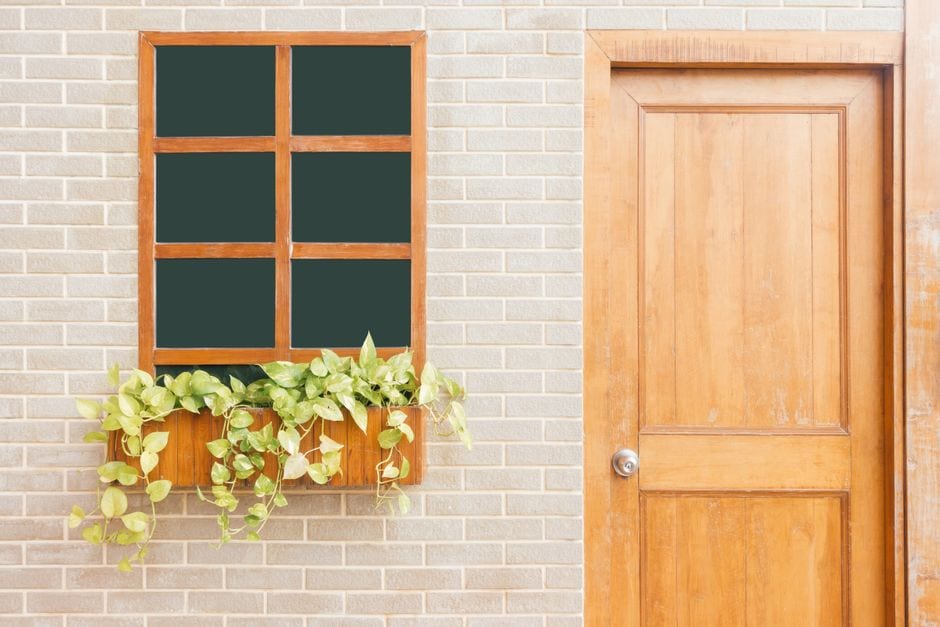
There are homes where conversation seems to begin before you have put your bag down, and homes where the first thing you want to do is exhale.
Some become gathering places, with another chair pulled to the table and someone always looking for the good serving bowl.
Others hold a quieter rhythm, inviting study, solitude, or the kind of reflection that rarely survives a busy afternoon.
We usually describe these differences through layout, family habits, memories, and the people living there.
Numerology offers another way of entering that conversation: what might the numbers and names of a place invite us to notice?
Here in Central Florida, where we can move between cities without much interruption in the scenery, the idea becomes especially intriguing.
A household sits within a street, a city, a state, and a postal area, each carrying a name or number of its own.
We think of this as nested numerology, a way of exploring the symbolic layers surrounding the place we call home.
Start With the Number on the Door
House number numerology begins by adding the digits of the street number and reducing the result.
For example, 1580 becomes 1 + 5 + 8 + 0 = 14, and 1 + 4 = 5.
Written as 14/5, the result preserves both the intermediate total and its single-digit root.
The same root can arrive through different routes: 23 becomes 23/5, while 32 becomes 32/5.
Keeping the intermediate number visible allows readers who work with compound-number symbolism to consider that additional detail.
For this exploration, we will keep 11, 22, and 33 when they arise as reduction totals, while also noting their roots as 11/2, 22/4, and 33/6.
An apartment adds another question: are you considering the whole building, your particular unit, or both?
You can record the building and unit separately as layers; some practitioners instead combine them, so label your approach before interpreting it.
What the Numbers Symbolize
Western numerology reads numbers as archetypes, with each expressing a range of possibilities.
In the traditional symbolic vocabulary, one suggests initiative and independence; two, cooperation and sensitivity; and three, expression and creativity.
Four speaks to structure and steady effort; five to freedom, variety, and change; and six to care, responsibility, and home.
Seven brings contemplation and inquiry, eight concerns stewardship and material accomplishment, and nine evokes compassion and completion.
World Numerology’s number guide offers a starting point for exploring these associations.
The interesting question is how a quality finds expression in daily life.
Consider a household that values hospitality: does welcoming people feel nourishing, or has the woman who hosts everyone quietly become the unpaid manager of everyone’s comfort?
Or consider a home devoted to quiet: is solitude restoring its residents, or have they stopped inviting anyone through the door?
The interpretation becomes useful when it opens an honest conversation.
The Particular Invitation of a 14/5 Home
Five is often associated with movement, curiosity, flexibility, and an appetite for experience.
In a household reading, that might suggest a lively space where plans evolve, visitors appear, and several interests compete for the kitchen table.
The affectionate phrase “controlled chaos” may feel familiar, although the amount of control can depend on when you last located your keys.
Some numerology traditions classify fourteen as a karmic debt number, associating it with lessons around freedom, moderation, and commitment.
That is a particular spiritual interpretation, not a conclusion that an address establishes anyone’s past-life history.
Our invitation would be to work with the constructive question: what helps freedom remain nourishing?
A busy household could experiment with one shared evening meal, a dependable place for essentials, or a small pocket of quiet that remains available even when the rest of life is moving.
These are conscious choices prompted by reflection, rather than remedies guaranteed by a number.
Does the Street Name Include Drive or Lane?
Letter-based numerology requires a conversion system, and this article uses the Pythagorean chart.
The values repeat through the alphabet: A, J, and S equal 1; B, K, and T equal 2; C, L, and U equal 3.
D, M, and V equal 4; E, N, and W equal 5; F, O, and X equal 6.
G, P, and Y equal 7; H, Q, and Z equal 8; I and R equal 9.
Ignore spaces and punctuation, assign each letter its value, add them, and reduce the total.
There is no single convention shared by every practitioner for including Street, Drive, Lane, or Boulevard.
World Numerology’s address method uses the name as you normally speak it, including the suffix when you ordinarily say it and spelling out abbreviations.
We will follow that spoken-name convention here, recording exactly what we calculate rather than switching spellings to obtain a preferred result.
A Worked Example With Several Layers
To explore a complete address without sharing anyone’s home location, imagine a fictional household at 1409 Maple Lane in Saint Cloud, Florida, using ZIP code 34771.
The house and street are invented for this exercise; the city, state, and ZIP code provide the regional setting.
The house number gives 1 + 4 + 0 + 9 = 14, then 1 + 4 = 5.
For Maple, M = 4, A = 1, P = 7, L = 3, and E = 5, giving 20.
For Lane, L = 3, A = 1, N = 5, and E = 5, giving 14.
Together, Maple Lane totals 34, reducing to seven.
If the spoken name were Maple Lane Drive, Drive would add 31, producing 65, then 11, recorded as 11/2.
That difference shows why choosing a convention matters.
Saint totals 18 and Cloud totals 19, so Saint Cloud gives 37, then 10, then one.
Florida gives F = 6, L = 3, O = 6, R = 9, I = 9, D = 4, and A = 1, totaling 38, then 11/2.
The ZIP code gives 3 + 4 + 7 + 7 + 1 = 22, retained here as 22/4.
Writing Saint rather than St matters too: St Cloud totals 22, showing how abbreviation changes the calculation.
Reading the Layers Together
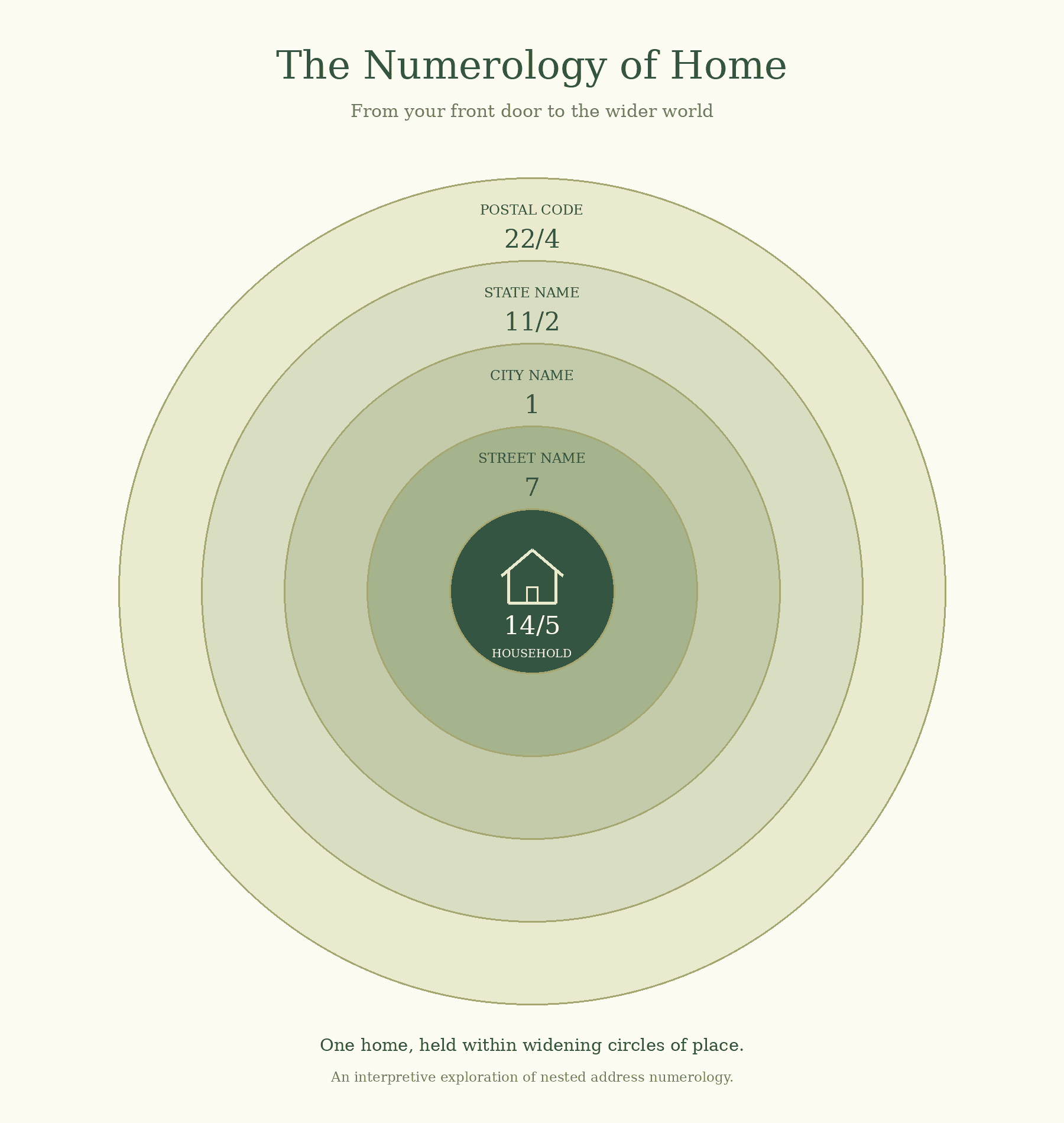
This fictional example places a 14/5 household within a seven street-name layer, a one city-name layer, an 11/2 state-name layer, and a 22/4 postal layer.
The layered reading is the interpretive framework proposed here; extending the calculation to city, state, and ZIP code is an exploration rather than a universally prescribed address method.
Picture it as a set of concentric circles, beginning at the front door and widening into the surrounding place.
Five and seven offer an especially interesting pairing: room for experience alongside room to absorb it.
A reader might ask whether her household has plenty of stimulation but too little time to reflect on what everyone is experiencing.
Or perhaps quiet has become so protected that spontaneity struggles to find an opening.
The one, read through its association with initiative, could prompt questions about taking action in the wider community.
In numerology’s master-number symbolism, eleven emphasizes intuition and sensitivity, while twenty-two connects vision with practical building.
Applied reflectively here, those associations invite a question: how might an inner conviction become something useful in everyday life?
The state and ZIP layers are shared by many households, so they cannot describe one family’s unique character.
Nor does a postal boundary establish that an energetic field begins or ends there.
The value of this wider view lies in the relationships and questions it helps us explore.
Photo by Arina Krasnikova on Pexels. Illustrative stock photograph.
Bring Your Own Experience to the Reading
Before calculating anything, write down three observations about living in your home.
Notice what happens when you arrive, what people tend to do there, and what you repeatedly wish had more room.
Then calculate your numbers and compare the symbolism with those observations.
Where does an association illuminate something familiar, and where does it simply fail to fit?
Allow both answers, because honest attention includes recognizing a mismatch.
Household size, finances, working patterns, relationships, and the physical space all shape daily life.
A number is a symbolic lens, not an established explanation of those conditions.
Different residents may also experience the same home differently, which can make comparing notes more revealing than searching for a single correct description.
You could repeat the exercise with a previous home, using your actual memories rather than trying to make its history match its number.
Make Room for the Life You Want to Live
The most meaningful part of this exploration begins after the arithmetic.
If your reflections reveal a longing for stillness, where could you create a place to sit undisturbed?
If they reveal a desire for connection, who might you invite for tea?
If the household feels scattered, what small agreement would make living together easier?
Consider pairing your observation with a blessing for your home, or creating a small sacred space where you can return to yourself.
You might stand at the doorway and name what you hope this home will hold: truthful conversation, welcome, rest, laughter, or the freedom to grow without losing touch with yourself.
Then choose one ordinary action that gives that intention a place to live.
Your relationship with home is something you participate in every day, through what you bring through the door and what you make room for within it. |

More from Resonant
Oct 24, 2026
An Herbal Tea Garden Can Begin With One Pot
Grow a little of what fills your cup, and let tending, harvesting, and brewing become everyday practices of presence and gratitude.

Oct 23, 2026
Mirror Work Does Not Require You to Lie to Yourself
A reflective practice can begin with recognition rather than forced positivity or promises of instant healing
Oct 23, 2026
A Morning Ritual Should Return You to Yourself
A gentle practice for beginning the day with attention before the world begins making requests

Oct 23, 2026
Ecstatic Dance Invites the Body Back Into the Conversation
What to expect from free-form conscious dance, and how to enter an Orlando-area gathering with curiosity and consent
0 Comments
Join the conversation
Be the first to comment
Share your thoughts above.