
Where Orlando Goes to Be Quiet |
Beyond the noise of everyday life, Central Florida's quiet places invite us to reconnect with the rhythms of nature, the intelligence of the body, and the deeper stillness within. |
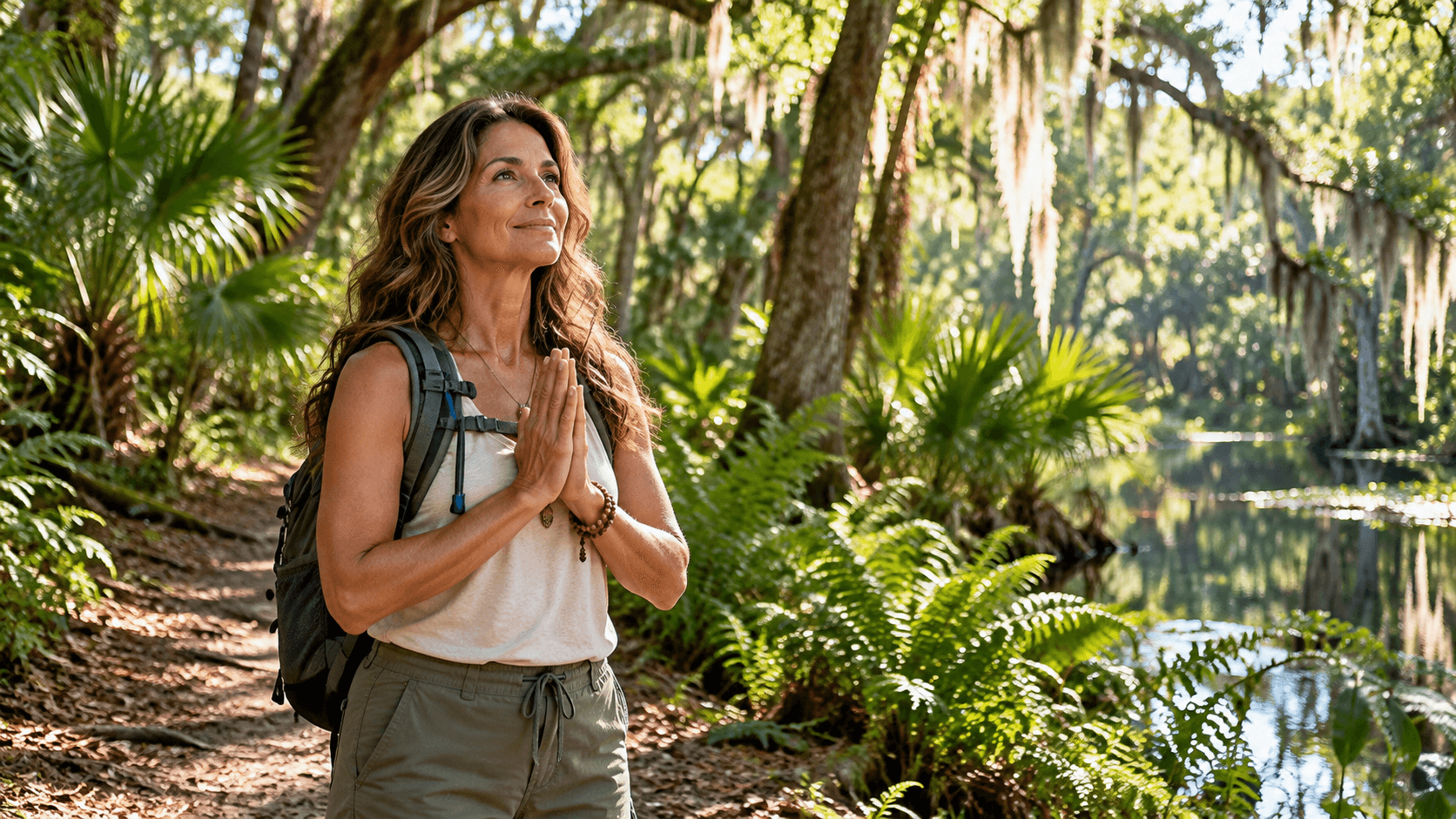
Orlando is a city that knows how to capture our attention. Its attractions promise spectacle, its roads carry us from one obligation to another, and even our moments of rest can become opportunities to consume more information. Yet scattered throughout Central Florida are places that ask almost nothing of us. They invite us to notice the wind, follow the movement of water, and remember what it feels like to inhabit our bodies without rushing toward the next thing.
Perhaps we seek these places for a reason deeper than the desire to escape noise. Perhaps we are longing to recover a rhythm that modern life has taught us to overlook.
The Body Knows When It Can Exhale
When we move through demanding environments, our attention is continually recruited by decisions, interruptions, and expectations. The body participates in that experience through changes in breathing, muscle tension, and autonomic nervous-system activity. Rest is not simply a decision made by the mind; it is also a physiological process that our surroundings can help support.
Natural environments can offer a gentler field of attention. A shifting canopy of leaves holds our interest without asking us to solve anything. Birdsong and moving water provide sensory detail without the urgency of an alert. Research on exposure to nature suggests benefits for stress and psychological well-being, although no particular park or single visit can guarantee a specific outcome.
At Kraft Azalea Garden in Winter Park, the broad expanse of Lake Maitland appears beyond mature trees and shaded ground. You can sit near the water and allow your breathing to find its own pace. Nothing about the lake demands that you become calmer. Its gift is the opportunity to stop trying so hard.
The Rhythms We Have Not Outgrown
Long before electric lighting and calendars filled with appointments, human life unfolded in close relationship with daylight, darkness, weather, and the seasons. Those relationships remain written into our biology. Light helps regulate our circadian clocks, influencing sleep and wakefulness, while the changing conditions of the natural world continue to shape how we experience each day.
At Mead Botanical Garden, also in Winter Park, the rhythm of life is visible in the smallest details. Leaves emerge, flowers open, insects move through the understory, and birds respond to the changing light. Walking among these living processes can become a quiet reminder that we belong to a world whose cycles do not begin and end with our personal schedules.
In spiritual traditions, attunement to nature is often understood as more than a pleasant pastime. It can be a way of recognizing our participation in something larger than the individual self. The experience does not require a particular belief. It begins with attention, and with the humility to recognize that the Earth has its own ways of keeping time.
The Rhythm Beneath Our Feet
The planet also has an electromagnetic environment. Among its naturally occurring phenomena are the Schumann resonances, a set of extremely low-frequency electromagnetic resonances within the space between Earth's surface and the ionosphere, generated primarily by lightning. The fundamental resonance is commonly described as approximately 7.83 hertz, with additional resonant modes at higher frequencies.
For some people who approach nature through metaphysical and energetic teachings, the existence of these planetary rhythms offers a compelling image of connection. The Earth is not an inert platform on which life happens; it is a dynamic environment with patterns and processes of its own. For those who experience nature through a spiritual or energetic lens, these planetary rhythms invite reflection on our connection to the living Earth.
The distinction need not diminish the spiritual invitation. We can contemplate our relationship with the planet without claiming to have measured every dimension of that relationship. Standing beneath a tree or beside a lake, we may simply remember that we are not separate from the living systems around us.
Grounding as a Practice of Presence
One of the simplest ways to explore that relationship is through grounding. In contemplative practice, grounding often means returning attention to immediate physical experience: the pressure of the feet against the ground, the movement of the breath, the temperature of the air, and the sensations that tell us where we are.
Earthing takes that connection into the physical realm through direct contact with the Earth's surface, whether by standing barefoot on grass, resting on natural ground, or allowing the hands to touch the soil. Within earthing practices, this contact is understood as an opportunity for the body to reconnect electrically with the planet, and advocates associate it with relaxation, restorative sleep, and a greater sense of balance. Beyond any particular outcome, the practice invites us to experience the Earth not as scenery beneath our feet, but as a living environment with which we are in continual relationship.
At a safe, permitted spot in a garden or on a natural trail, try pausing long enough to feel your weight settle through your feet. If conditions allow barefoot contact, first consider the terrain, cleanliness, park rules, and any personal health risks; shoes are perfectly compatible with a grounding practice. Notice the air against your skin and the sounds arriving from different directions. You do not have to force an altered state. You are practicing being here.
Where Orlando Makes Room for Stillness
The quiet we need does not always require wilderness. Dickson Azalea Park, tucked into an Orlando neighborhood, follows a shaded creek beneath old trees. Its paths and historic bridge create a pocket of calm within the city. A brief visit can remind us that restoration need not be reserved for vacations or special occasions.
For a deeper immersion in protected habitat, Tibet-Butler Preserve offers trails near the region's bustling tourism corridor. There, the contrast between human schedules and ecological rhythms becomes especially apparent. A walk invites attention to the ground underfoot, the movement of wildlife, and the simple fact that the landscape does not exist for our entertainment.
There are also forms of quiet that are deliberately cultivated indoors. Chapels, prayer rooms, and meditation sanctuaries offer spaces where stillness is a shared intention. Some visitors enter through prayer, others through contemplation, and others simply through the relief of sitting somewhere without needing to speak. Spiritual quiet need not mean an absence of sound; it may mean an absence of performance.
Silence Is Not the Same as Inner Stillness
A person can sit beside a beautiful lake while mentally rehearsing a difficult conversation. Another can feel deeply centered amid birdsong, wind, and moving water. This is why the search for quiet cannot be reduced to finding the most secluded location. External silence and internal coherence are not the same thing.
The transition from one to the other may begin with an unremarkable choice: putting away the phone, relaxing the jaw, lengthening an exhale, or allowing a thought to pass without following it. These are small acts, but they change the quality of our participation in a place. We stop treating nature as scenery and begin relating to it as an environment we are part of.
The Quiet We Carry Home
Before setting out, check current opening hours, accessibility, and local rules, and remember that these spaces are shared with wildlife and other visitors. Quiet is something we can help preserve through the way we move, speak, and care for the places that welcome us.
The next time Orlando feels relentlessly loud, consider visiting somewhere that has nothing to sell you and nothing it needs you to become. Sit near Lake Maitland, follow a wooded trail, or find a place where prayer and silence are welcome. Let the world continue around you without trying to direct it.
Perhaps the deepest gift of these places is not that they remove us from ordinary life. It is that they return us to it with a little more awareness of the body we inhabit, the planet that sustains us, and the quiet that can emerge when we remember how to listen. |
More from Resonant

Oct 10, 2026
Where Orlando Goes to Make Something Beautiful
From pottery and painting to floral design and mosaic art, discover creative experiences across Central Florida that invite you to make something beautiful with your own hands.

Oct 10, 2026
The Women Who Fed Us: Food, Memory & Heritage | Resonant
Explore how family food traditions, sensory memory, and culinary heritage connect generations across Central Florida.

Oct 10, 2026
Alignment Is Not What You Think: The Forgotten Meaning of Spiritual Alignment
True spiritual alignment begins when our thoughts, emotions, words, and actions become coherent, and deepens when our personal will comes into harmony with the wisdom of our Higher Self.

Oct 10, 2026
The Unseen Cost of Unconscious Speech: BioAwareness™ and the Language We Carry
What happens when we become so accustomed to speaking the language of war that we no longer recognize it in our everyday lives?
0 Comments
Join the conversation
Be the first to comment
Share your thoughts above.